Invasive Plant Species
Invasive plant species are those which were introduced—intentionally or accidentally—into an area outside their native range; they negatively affect the existing ecological system of a particular area. Plants from around the world have been brought to North America for centuries. The plants existing here prior to their introduction co-evolved with each other in sustainable and diverse ecologies.
Many of the introduced species have no natural predators or checks on their expansion, and many became widely established and sometimes invasive. Over time, we can see ecological disruptions caused by invasive species, climate change, human development, and destruction of old growth ecosystems.
Not all introduced species become invasive, as that term is understood. An “invasive species” is defined as one that causes harm when introduced into a natural environment. The species can be a plant (think phragmites, autumn olive, and invasive honeysuckle), an animal (wooly adelgid, which attacks hemlock trees, and Asian jumping worms, which strip nutrients and organic matter from soil, come to mind), or a fungal pathogen (such as those living on the introduced fungi that caused “Dutch elm disease”). Sometimes there is a combination—beech bark disease is the result of a non-native scale insect and several species of Neonectria fungi.
Invasives cause harm by reducing biodiversity when introduced plants, facing no impediments to rapid growth in their new environment, out-compete native plants that do not have time to evolve and adapt (garlic mustard and stiltweed are common examples). Some invasive plants directly attack native species (as with lesser celandine). Invasives in Michigan cause billions of dollars in agricultural losses annually, when crops are ruined (by spotted knapwood and multiflora rose, for example) and timber production forests are degraded (common buckthorn outcompetes young trees). There is harm to air quality and the costs of a hotter climate when native trees, shrubs, and grasses, all of which sequester carbon, heat, and water, are lost to invasive bugs and pathogens. Dandelions, on the other hand, although they are introduced, do not cause harm; in fact, they provide some benefits. They help aerate hard soil. With a long central root they bring up nutrients that are too deep in the soil for young trees and shrubs to reach otherwise. And they add organic matter back into the soil when they decompose. Dandelions are therefore not classified as invasive.
Resources
Michigan has 22 CISMAs (Cooperative Invasive Species Management Areas). The Jackson, Lenawee and Washtenaw (JLW) CISMA works in our area, seeking to address prevention, detection, and controlling of invasive species through public education and outreach to local communities. The JLW CISMA is a partnership that includes the Washtenaw County Conservation District, one of our chapter’s key partners.
The Michigan Natural Features Inventory (MNFI) is arguably the single best resource for learning about and understanding Michigan flora, both native and invasive. MNFI maintains a growing database of native plants and naturally occurring plant communities that are uniquely ours in its Natural Heritage Database. They interpret the data and deliver it to governmental agencies, NGOs, industry, researchers, and the public.
The Midwest Invasive Species Information Network (MISIN), a regional effort hosted by Michigan State University, is committed to the development and application of early detection and rapid response for invasive species. Particular to our area, Michigan MISIN has tools for reporting sightings of suspected or known invasive species, programs to address some specific invasives deemed particularly damaging, and a tools dashboard to help you identify and report invasives and to receive data and information. MISIN works closely with the Michigan Invasive Species Grant Program, which provides funding for programs managed by several state agencies.
- Michigan’s Terrestrial Invasive Species State Management Plan
- Michigan Invasive Species Program
- A Field Identification Guide to Michigan Invasive Plants
Various cell phone apps are now very helpful for identifying plant and insect species, with an imperfect but pretty good record of identification. Favored for its rich network of citizen scientists who will verify or contradict an electronic ID is iNaturalist. Picture This and PlantNet score high for ID accuracy and may be easier to use. There are others, and your location may factor in the app you choose to use.
Other Threats
The list of challenges to native plants is daunting. It includes species such as invasive stiltgrass (Microstegium vimineum), native white-tailed deer (detailed discussions below), fragmentation in the environments that should be connected, and human development. We will add other discussions as we can. Local threats to natural areas by human activity will be primarily addressed through our advocacy positions.
Discussion of Some Specific Threats
Native White-tailed Deer
Given our mission, we immediately recognize the necessity of doing what we can to root out (literally) invasive plants, or at least (when eradication is not possible) to manage them as best we can. If invasive plants are not checked, they spread and compete with the native plants that are the engine of our ecosystem. This much is incontrovertible.
But how, then, should we consider the problem of too many deer in our environment? We know that there are too many deer (in southern Michigan and elsewhere), a problem that adversely affects humans—think deer-car collisions, crop losses, the spread of ticks—and the deer themselves, many of which die from starvation; devastating and fatal chronic wasting disease; epizootic hemorrhagic disease; and car crashes. At Wild Ones Ann Arbor Area, our focus is to support individuals and organizations in creating plant ecologies that sustain all the different lives within them—plants, bugs and other insects, birds, amphibians, fish, mammals, fungi, and beneficial microorganisms. In this context, our concern about deer is focused on the direct threat to biodiversity arising from damage to plants caused by excessive browsing, and related harms to soil and water.
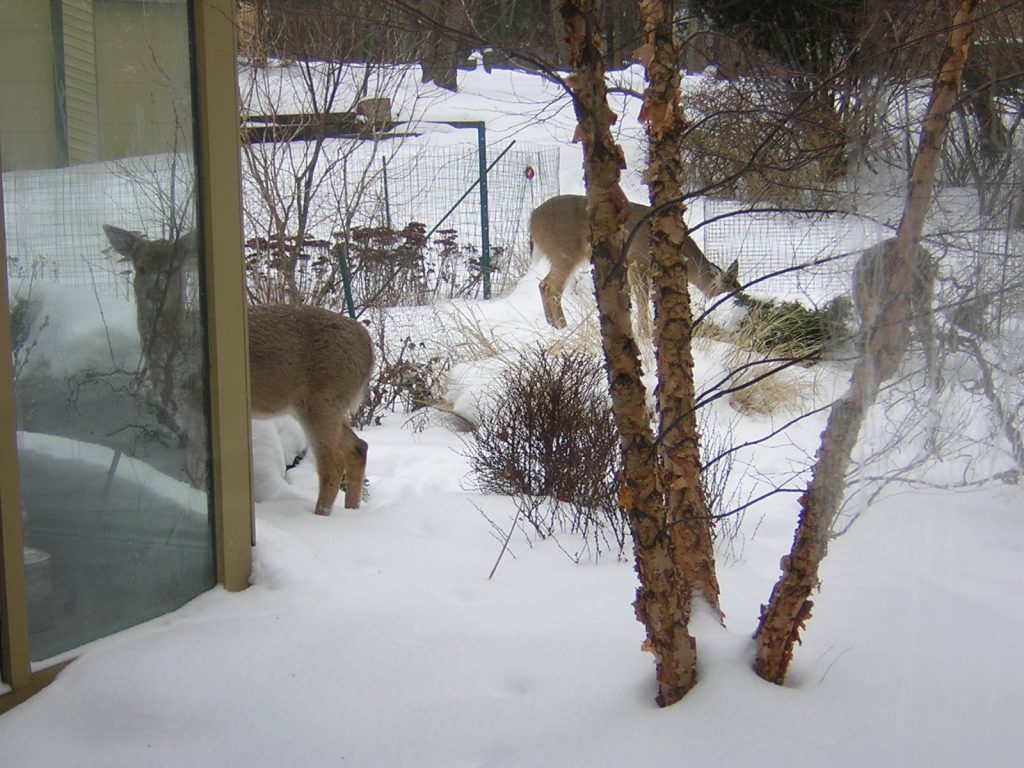
In the early 1900s, deer had disappeared in southeast Michigan. They were reintroduced and there was migration from Up North in the 1920s. Herds grew, and by the 1940s, deer populations crashed due to overabundance and starvation. Today, we again have an overabundance in urban areas, with current numbers believed to be higher (in Michigan and throughout the U.S.) than in pre-European settlement times. Deer herds have grown because increased agriculture offers them more forage, major predators have been extirpated, edge habitats between natural and urban areas are favorable to deer, winters have been warmer overall, and there are fewer hunters.
White-tailed deer favor white pine, red pine, maple, oak, beech, eastern cedars, and even woody shrubs in winter, and they will turn to herbaceous shrubs and forbs (herbaceous perennials) as the weather warms. When there are too many deer, forest understory growth and growth in similar stands in natural areas is destroyed. The trees and plants cannot regenerate themselves because they cannot grow faster than the rate at which they are browsed—they end up nibbled to stubs. Native forbs frequently get replaced by invasive species that do not support insect life or soil health. Without trees and forbs, bee and butterfly populations drop, along with their larvae and caterpillars on which birds depend. Conservationist Doug Tallamy has referred to the loss of insect life we are currently experiencing as “insect apocalypse.” A single pair of breeding chickadees needs 6,000–9,000 caterpillars to rear a single clutch of young—we can easily see that an insect apocalypse very quickly becomes a bird apocalypse. In addition, when trees and shrubs are browsed to the ground, ground-nesting birds lose their habitat, and often their lives. Carbon sequestration in the soil is dramatically reduced, and rivers are deprived of cooling shade, extending the harm to aquatic life.
And it isn’t just forests and nature preserves that suffer. Much of Wild Ones’s focus is on residential yards, typically in urban and suburban settings. Our yards play a crucial part in maintaining biodiversity and serving as a linked habitat for wildlife of almost all kinds (except large predatory mammals, for the most part). A 2005 study estimated that lawn in the continental U.S. totals more than 63,000 square miles, or about 40 million acres, an area three times larger than that given over to any irrigated crop. Most of what we commonly call lawn, as a general rule, is made up of non-native grasses that depend highly on fertilizers and pesticides and do not support a diversity of wildlife. If even half of these lawn acres are converted to wildlife-friendly native plants, we will have created a powerful defense against the risks of apocalyptic extinctions. But deer do their harms in these urban and suburban settings, as almost all gardeners know. Native plants are their favorites.
Two different experiences may help us think about this problem.
The Ann Arbor Cull
One experience is the story of Ann Arbor’s recent deer cull. From 2016-2020, Ann Arbor maintained a deer management program, which included monitoring deer numbers, conducting area-limited sharpshooter culling of certain herds, and sterilizing a smaller number of deer. The cull produced promising results, although a 2019-2020 study of its effects concluded that although browse levels were reduced, they were still too high to allow oak tree regrowth and forest replacement, suggesting that a future cull might be necessary. Also during that period, a group of Wild Ones members organized a special effort dedicated to deer management, the Washtenaw Citizens for Ecological Balance (or wc4eb, for short). A good informational website was created as part of this effort. However, the city program was not renewed after 2020, and among the casualties was any effort to gather data regarding deer herd sizes or ongoing deer impacts on vegetation in our area.
The University of Michigan E.S. George Reserve
Another story was described when Ann Arbor was considering whether to fund the deer cull in 2016 or to delay it. University of Michigan Professor of Ecology and Evolutionary Biology Christopher William Dick supported allocating the funds sooner rather than later, and in so doing he summarized the experience at University of Michigan’s E.S. George reserve in Livingston County:
“In 1930 six whitetail deer were introduced in the reserve. In six years that number increased to 160 deer. UM biologists learned about the exponential growth rates of whitetail deer. They also noted that deer overabundance destroyed the forest understory and stopped forest regeneration. In order to maintain ecological balance, U-M has periodically culled its deer herd since the early 1940s.”
Of added interest is that the reduced number of individuals in the George Reserve herd helped stave off the spread of ticks and the diseases they carry, and in this way culling the herd actually helped the remaining deer and overall health of the herd. The herbaceous plants and native tree seedlings in the reserve rebounded and have become a lush forest understory. This has led to deer management decisions in some years to forego culling, as unnecessary.
Deer impact the composition of vegetation in our natural areas and suburban yards. Deer influence habitat for birds and other wildlife and their breeding. They alter the number of caterpillars, pollinators, and birds in their environment. Deer also change the quality of soil, through compaction, and because reduced herbivory results in bleaching certain nutrients at the soil surface. So here is the challenge: What is the best management of local deer populations, and what is an appropriate decision-making process for resolving deer management controversies?
One thing is for sure—ignoring the issue will undermine our best efforts to create sustainable and healthy natural environments.
Japanese Stiltgrass
Scientific name: Microstegium vimineum (Trin.) A. Camus
(commonly known as Japanese stiltgrass, packing grass, or Nepalese browntop)
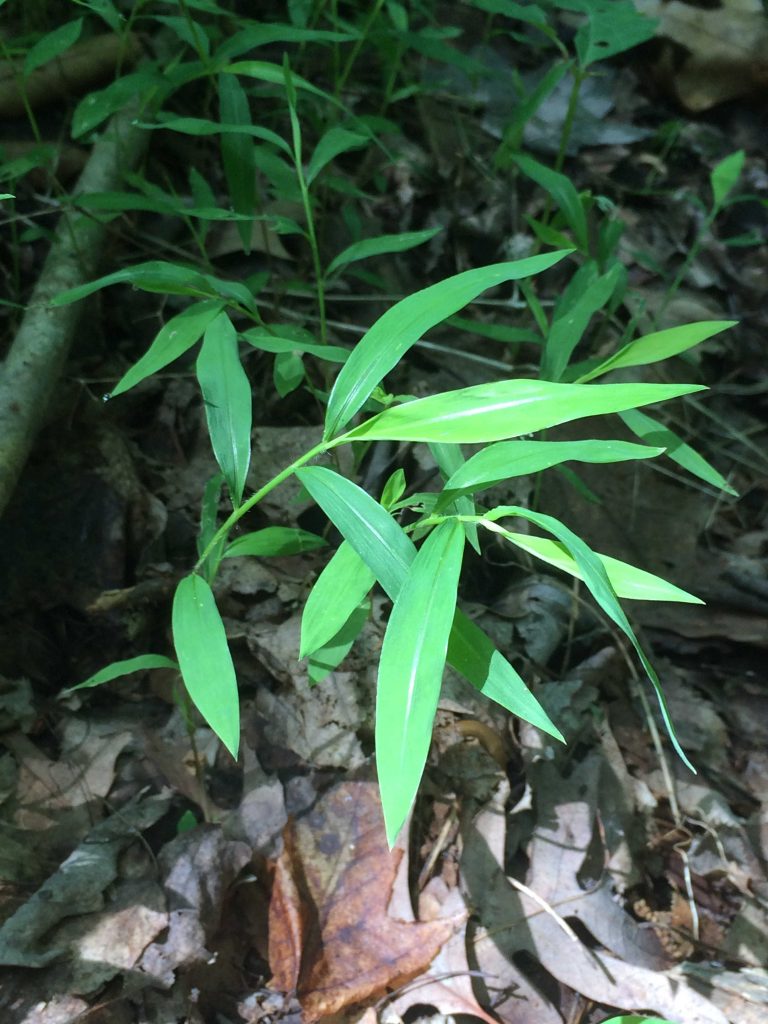
Microstegium vimineum is listed by the US Forest Service as a Category 1 invasive species in the Eastern Region of the USA; these are described as highly invasive plants which invade natural habitats and replace native species. M. vimineum was recently ranked as the number one invasive plant of concern by researchers and land managers in the Eastern USA. (OEPP/EPPO Bulletin (2016) 46 (1), 14–19: Microstegium vimineum (Trin.) A. Camus)
This sprawling grass can grow in almost any environment. It produces copious small seeds that spread through water runoff, wildlife (especially deer), foot and vehicle traffic, and lawnmowers. Stiltgrass can choke out native flora within three years. It has been identified in Ann Arbor, Scio Township, and in Lenawee, Cass, and Oakland counties.
Microstegium vimineum is listed by the US Forest Service as a Category 1 invasive species in the Eastern Region of the USA; these are described as highly invasive plants which invade natural habitats and replace native species. M. vimineum was recently ranked as the number one invasive plant of concern by researchers and land managers in the Eastern USA. (OEPP/EPPO Bulletin (2016) 46 (1), 14–19: Microstegium vimineum (Trin.) A. Camus)
This sprawling grass can grow in almost any environment. It produces copious small seeds that spread through water runoff, wildlife (especially deer), foot and vehicle traffic, and lawnmowers. Stiltgrass can choke out native flora within three years. It has been identified in Ann Arbor, Scio Township, and in Lenawee, Cass, and Oakland counties.
Two elements make stiltgrass difficult to control:
- Initial small patches blend in with native grasses and sedges in woodland edges and easily escape detection. Then, snow melt and spring rains allow seeds to flow downhill and into stream beds and turn a patch into a multi-acre infestation in one year.
- Seedlings emerge in early June, after native grasses and ferns are tall, and after the Spring Invasive Species Challenge sponsored by local CISMAs.
Stiltgrass seedlings appear in Michigan around Memorial Day and inflorescence around Labor Day.
If you have Stiltgrass, you should report it online at www.misin.msu.edu, or download the MISIN smartphone app and report it from your phone.
Resources
Stiltgrass ID and Its Look-a-Likes
Field Guide to the Identification of Japanese Stiltgrass with comparisons to other look-a-like species
Includes useful photographs and detailed description of structure, growing habits, and habitats.
Washtenaw Stiltgrass Working Group on Facebook
Supported by The Stewardship Network.